Storage · 13 August 2026
Airtight Containers for Indian Kitchens That Keep Food Fresh
Every Indian kitchen deals with the same set of problems. The atta goes stale faster than expected. The dal picks up moisture during the monsoon. The chilli powder loses its colour within weeks. The rice smells slightly off after a fortnight.
None of these are ingredient problems. They are storage problems — and the solution in every case is the same: proper airtight containers that seal out air, moisture, pests, and humidity consistently, every single day.
Why Airtight Storage Matters More in Indian Kitchens
Indian kitchens face storage conditions that are more demanding than most. The combination of heat, humidity, turmeric and masala staining, pest exposure, and the sheer variety of dry goods stored — rice, pulses, flour, spices, sugar, semolina, poha — means that ordinary containers fail faster and more obviously here than in most other environments.
The specific storage challenges Indian kitchens face:
- ** Humidity and moisture** — Especially during the monsoon, open or loosely sealed containers allow moisture to enter, causing flour to clump, rice to smell, and spices to lose potency within days.
- ** Pest exposure** — Weevils, ants, and other pantry insects find their way into any container with a gap in the seal. A genuinely airtight lid prevents this entirely.
- ** Odour transfer** — Strong spices like asafoetida and mustard seeds transfer odour easily. Containers that are not properly sealed allow cross-contamination between pantry items stored nearby.
- ** Temperature variation** — Indian kitchens cycle through high cooking heat and cooler ambient temperatures. Materials that expand and contract with heat — particularly certain plastics — lose their seal integrity faster over time.
- ** Staining** — Turmeric, red chilli powder, and oil-based masalas stain plastic permanently. Non-staining materials hold their appearance and hygiene standards far longer.
Airtight storage is not a luxury purchase for an Indian kitchen. It is a functional requirement that affects food quality, pantry hygiene, and household budget on a daily basis.
Material Comparison: Stainless Steel vs Plastic vs Glass
This is the most common question buyers ask — and the answer matters more than most product pages acknowledge.
Stainless Steel Airtight Containers
Food-grade stainless steel — specifically 304-grade steel — is the best long-term material for Indian pantry storage. Here is why it outperforms every alternative across every dimension that matters for daily use:
- ** Non-reactive** — Stainless steel does not react with acidic, salty, or spice-heavy ingredients. Your masalas stay chemically unchanged in a steel container for months.
- ** Zero odour absorption** — Unlike plastic, steel does not absorb or retain odours. You can store asafoetida in a steel canister one month and sugar the next without any flavour transfer.
- ** No staining** — Turmeric, chilli, and oil-based spices do not permanently stain steel surfaces. A quick wipe restores the original finish.
- ** Rust-resistant** — 304-grade food-grade stainless steel is inherently rust-resistant under normal kitchen conditions, including humidity.
- ** BPA-free by nature** — No chemical coatings, no plastic compounds, no leaching risk at any temperature.
- ** Durability** — A quality steel canister lasts 10 to 15 years without significant degradation. The seal gasket may need replacing over time, but the container itself remains functional indefinitely.
- ** Pest-resistant** — A properly sealed steel container is impenetrable to insects. No weevil has ever entered through solid food-grade steel.
Plastic Airtight Containers
Plastic containers are lightweight, inexpensive, and widely available. For Indian kitchens, they come with consistent limitations:
- Absorb odours from spices permanently over time
- Stain irreversibly from turmeric and masalas
- Degrade with heat cycling — the seal may become loose faster than steel equivalents
- Lower-grade plastics may leach chemicals into food, particularly under heat exposure
- BPA-free labelling is important but not universal — always verify before purchasing
Plastic works acceptably for short-term storage of neutral ingredients like sugar or pasta in a cool, dry pantry. For spices, masalas, and anything stored near heat sources, it is the weakest available option.
Glass Airtight Containers
Glass is non-reactive, does not absorb odours or stains, and allows full visibility of contents. For an Indian kitchen, glass containers have specific practical limitations:
- Heavy — particularly in larger capacities used for rice and flour
- Fragile — breakage risk is real in a busy kitchen environment
- Temperature sensitivity — sudden temperature changes can cause cracking
Glass works well for smaller quantities — spices, dry herbs, seeds — where the visibility advantage outweighs the weight and fragility concerns. For bulk staples like atta, rice, and dal, glass is impractical.
What Makes an Airtight Container Truly Airtight
Not every container labelled “airtight” delivers genuine airtight performance. The difference lies in three specific design elements:
The Seal Material
A silicone gasket or rubber gasket fitted inside the lid is the most reliable seal mechanism. Silicone maintains its flexibility and compression over years of use, does not degrade with heat cycling, and creates a consistent seal every time the lid is closed. Cheap plastic gaskets harden over time and develop gaps.
The Locking Mechanism
How the lid locks onto the body determines how consistently the seal is compressed. Clamp lids and thread-lock mechanisms — where the lid screws down firmly — provide more consistent compression than push-fit lids. A well-engineered thread lock or steel clamp creates the same seal pressure every time, regardless of how the lid is placed.
The Fit Between Body and Lid
The precision of the fit between the container body and the lid determines whether the gasket is compressed evenly around the entire perimeter. A poorly machined container will have uneven compression — airtight on one side, loose on the other. Quality manufacturers control this at the production level.
How to Choose the Right Capacity for Indian Pantry Staples
Capacity is where most buyers make mistakes — buying too small for bulk staples and too large for spices. Here is a practical guide for common Indian pantry items:
** Spices (chilli, turmeric, cumin, coriander):**
- 125ml to 450ml capacity
- Small quantities, high turnover — smaller canisters keep spices fresher by minimising air space inside
** Tea, coffee, sugar:**
- 450ml to 750ml capacity
- Daily use items — medium capacity strikes the right balance between accessibility and freshness
** Pulses and lentils (dal, chana, moong):**
- 750ml to 1350ml capacity
- Stored in bulk, used regularly — medium-large capacity prevents frequent restocking
** Rice and wheat flour (atta):**
- 2100ml to 3000ml capacity
- High-volume staples — larger containers reduce how often you refill and keep bulk quantities sealed properly
** Semolina, poha, flattened rice:**
- 750ml to 1350ml capacity
- Medium capacity, stored in moderate quantities
Buying a canister set in graduated sizes — rather than a uniform set of identical capacity — gives you the flexibility to match each pantry staple to the right container size.
Two JVL Canisters Built for the Indian Pantry
JVL Classicware has been manufacturing stainless steel kitchenware for over 40 years and is trusted by more than 10 lakh Indian families. Their canister range is built with food-grade materials and practical Indian pantry needs in mind — not just aesthetics.
If you are looking for airtight storage jars that genuinely protect your pantry staples, the >Fusion Canister is worth a close look. It is built with a durable polycarbonate body and a stainless steel cover with a secure steel thread lock that keeps contents fresh and moisture-free. The square shape makes it particularly efficient for pantry shelves — no wasted space between containers. It is food-grade, easy to clean, and available in seven capacity options from 125ml all the way to 3000ml, making it one of the most versatile single canisters in JVL’s range. The sleek polished finish adds a clean, organised look to any countertop or shelf.
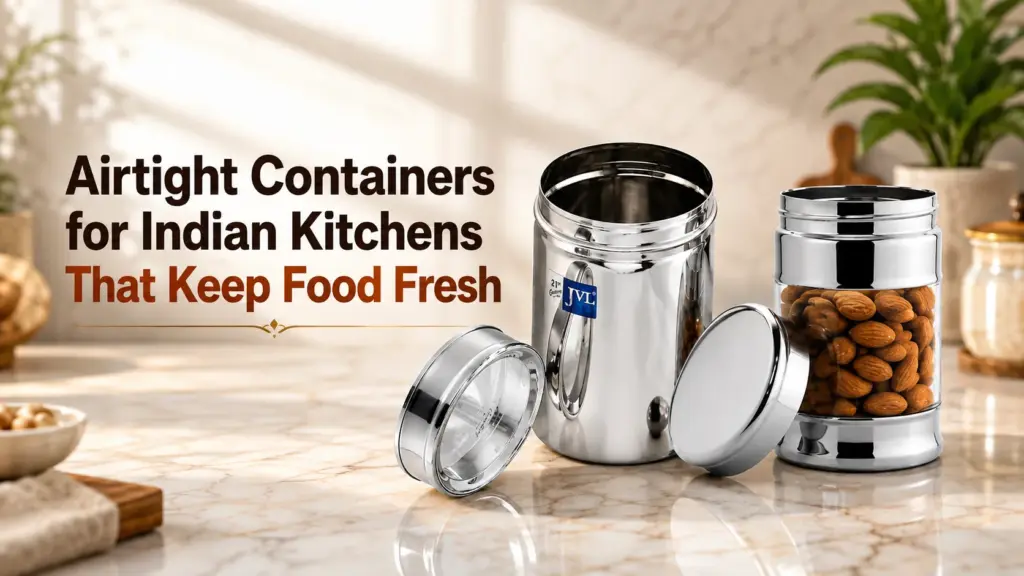
For buyers who prefer to see their contents at a glance without opening the canister, the >Vintage Clear Canister brings together the durability of food-grade certified stainless steel with a glass lid insert that gives you full visibility of what is stored inside. The cylindrical design with a secure locking mechanism maintains a tight seal against moisture and pests, while the high-quality polish and finish give it a premium look that works equally well on a countertop or inside a cabinet. Available in 450ml, 750ml, and 1250ml capacities — ideal for spices, tea, coffee, and medium-volume pantry staples.
Care and Maintenance Tips for Airtight Containers
Good airtight containers last years with minimal maintenance — but a few consistent habits extend their life significantly:
- ** Dry completely before filling** — Any residual moisture inside the canister before sealing will create a humid environment inside and accelerate spoilage rather than prevent it.
- ** Clean with a damp cloth only** — For steel canisters with polycarbonate or glass elements, a damp cloth wipe is the correct cleaning method. Avoid submerging in water or using abrasive scrubbers.
- ** Inspect the gasket periodically** — Silicone and rubber gaskets last years but are not permanent. If you notice the seal feels looser than usual, replacing the gasket restores the airtight performance completely.
- ** Store in a cool, dry location** — Even the best airtight containers perform better when not exposed to direct sunlight or extreme heat for extended periods.
- ** Label your canisters** — When buying matching or similar-looking canisters, labelling prevents mix-ups and makes pantry restocking faster and more organised.
The Bottom Line
Airtight containers for an Indian kitchen are not all equal — and the difference between a container that merely looks sealed and one that genuinely is sealed shows up in how long your pantry staples stay fresh, how clean your storage area remains, and how often you are throwing away spoiled ingredients.
Both are part of JVL’s broader canister collection, which you can explore in full at the >JVL Canisters and Jars collection page.
Frequently Asked Questions
Is stainless steel better than plastic for storing Indian spices?
Yes — significantly. Plastic absorbs odours and stains from turmeric, chilli, and oil-based masalas permanently over time. Stainless steel is non-reactive, does not absorb odours, does not stain, and maintains its hygiene standard indefinitely. For spices specifically, steel is the only material that preserves both the quality of the spice and the condition of the container over long-term use.
What grade of stainless steel should I look for in food containers?
304-grade stainless steel is the correct specification for food contact applications. It is food-grade certified, rust-resistant under normal kitchen conditions, and non-reactive with acidic or spice-heavy ingredients. 202-grade steel is lower quality and more prone to surface degradation over time — avoid it for food storage.
How do I know if a container is genuinely airtight?
The most reliable indicators are a silicone or rubber gasket fitted inside the lid and a secure locking mechanism — either a thread lock or a clamp lid. Press the lid down after closing and try to lift it with one hand — a genuinely airtight container with proper vacuum seal will resist easy opening. If the lid lifts with no resistance, the seal is not airtight.
Can airtight containers prevent weevils and pantry insects?
Yes — a properly sealed airtight container is impenetrable to pantry insects. Weevils, ants, and meal moths cannot enter through a secure steel or food-grade plastic seal. The key word is properly sealed — containers with worn gaskets or loose lids will still allow pest entry. Inspect your seals regularly and replace gaskets that have lost their compression.
Should I buy individual canisters or a set?
For most Indian kitchens, a combination of both works best. Buy a graduated set for your primary pantry staples — atta, rice, dal, sugar — where matching sizes look organised on a shelf. Then add individual canisters in specific capacities for spices, specialty flours, and other items where your household quantity differs from a standard set size.
How much does a 1-litre canister hold in terms of Indian pantry staples?
A 1-litre canister holds approximately 750 grams of most common pantry items — flour, sugar, or rice. Denser ingredients like dal and whole grains may hold slightly more by weight; lighter ingredients like poha or beaten rice will hold slightly less. Always check dimensions and capacity against your actual storage quantities before purchasing.