Kitchenware · 20 August 2026
The Moment She Realised Every Plastic Container in Her Kitchen Was Working Against Her Family
It started with a small thing. She was heating leftover sambar in a plastic container, something she had done hundreds of times, when she noticed the container had warped slightly at the base. Not broken. Not melted. Just changed, quietly, from the heat. And for the first time she found herself wondering what else had changed that she could not see.
That question, what is happening inside the plastic I cannot see, is the question that has been quietly building in Indian kitchens for years. Most of us grew up with plastic containers as a given. Lightweight, cheap, colourful, available everywhere. The idea that they might be the most dangerous thing in the kitchen was not something anyone told us to consider.
The evidence now says otherwise. And once you understand what plastic actually does to food, particularly Indian food, with its heat, its acidity and its spice, the switch to stainless steel stops feeling like an upgrade and starts feeling like a correction. A correction that should have happened earlier, and that the whole family benefits from the moment it does.
What Plastic Is Actually Doing to Your Food Right Now
The most important thing to understand about plastic containers is that they are not stable. They are designed to appear stable, to hold their shape, to look the same week after week, but at a chemical level, plastic is always interacting with whatever it touches, particularly under the conditions that define Indian kitchen use.
BPA and why removing it was not enough:
BPA, bisphenol A, is a chemical used in the manufacture of hard plastics that has been identified as an endocrine disruptor. Endocrine disruptors interfere with the body’s hormonal systems, and the concern with BPA specifically is that it mimics oestrogen in the body in ways that have been linked to developmental, reproductive and metabolic health concerns.
The response from manufacturers was to remove BPA and market containers as BPA-free. The problem is that BPA was replaced with structurally similar compounds, BPS, BPF and others, that research suggests may carry the same endocrine-disrupting properties. BPA-free does not mean chemical-free. It means one specific chemical was removed and another substituted.
Phthalates and what they do:
Phthalates are plasticisers, chemicals added to plastic to make it flexible and durable. They are also endocrine disruptors, associated in research with hormonal disruption, reduced fertility and developmental concerns in children. Phthalates leach from plastic containers into food under heat, and the rate of leaching increases significantly with temperature.
Microplastics, the problem no one anticipated:
As plastic containers age, degrade and develop micro-scratches from serving spoons and cleaning, they release microplastic particles directly into food. These particles are now documented in human blood, tissue and breast milk. The long-term health implications of chronic microplastic exposure are still being studied, but the direction of the research is not reassuring.
What makes Indian cooking specifically high-risk:
- Indian food is stored hot in containers frequently, the leaching rate of chemical compounds from plastic increases significantly with temperature
- Acidic ingredients, tamarind, tomatoes, citrus, vinegar-based pickles, accelerate chemical leaching from plastic surfaces
- Spice oils in masalas penetrate plastic and create ongoing contact between the plastic surface and the food stored inside
- Reheating food in plastic containers, common in Indian households, exponentially increases the exposure compared to cold storage alone
The cumulative daily exposure across three meals, across years of use, across every member of a family, this is the calculation that makes the switch from plastic to steel not a preference but a priority.
Why Stainless Steel Has None of These Problems
The reason stainless steel is safer than plastic is not complicated. It is safer because it does not contain any of the compounds that make plastic dangerous, and its physical properties prevent the interactions that cause those compounds to enter food in the first place.
304 stainless steel, what the grade means:
Food-grade 304 stainless steel, also called 18/8 steel for its composition of 18% chromium and 8% nickel, is the material standard for food contact surfaces in professional kitchens, hospitals, food processing facilities and quality home cookware worldwide. The chromium content creates a passive oxide layer on the surface that makes the steel non-reactive, self-repairing and resistant to corrosion under normal food contact conditions.
Non-reactive, what this means for Indian food:
When tamarind-based sambar sits in a 304 steel container, the acidity of the tamarind does not interact with the steel surface. When a tomato-heavy curry is stored overnight in steel, no chemical exchange occurs between the food and the container. The steel does not contribute anything to the food, no taste, no odour, no chemical compound, regardless of how acidic, spiced or salty the food is or how long it is stored.
Non-porous, what this means for hygiene:
At a microscopic level, plastic surfaces are full of tiny channels and crevices, created during manufacture and deepened by use, where bacteria, spice oils and food residue collect and cannot be fully removed by normal washing. This is why plastic containers develop a permanent smell after storing dal or pickle. The odour is not on the surface. It is in the surface.
Stainless steel is non-porous. There are no microscopic channels for residue to enter. The surface that touches the food is the same surface that contacts the cleaning cloth. This is why a steel container that stored fish curry last week smells completely clean after washing, because it is completely clean after washing, not just clean-appearing.
Why turmeric cannot stain steel:
The yellow staining that turmeric leaves on plastic is not a surface deposit. It is a penetration, the curcumin compound in turmeric enters the porous plastic surface and cannot be removed because it is now inside the material. Food-grade steel does not allow this penetration. The turmeric sits on the surface, is removed in washing and leaves nothing behind. This is a visible, daily demonstration of the same non-porous property that prevents chemical leaching and bacterial colonisation.
The Cutting Board Is Where the Microplastic Problem Is Most Visible
Of all the plastic surfaces in an Indian kitchen, the cutting board produces the most direct and measurable transfer of plastic into food. Every knife stroke across a plastic cutting board cuts microscopic particles of plastic directly into the food being prepared. Research published in food safety journals has quantified this, a plastic cutting board sheds millions of microplastic particles into food over its lifetime of use.
This is not a theoretical risk. It is a physical process that happens every time a knife contacts a plastic surface.
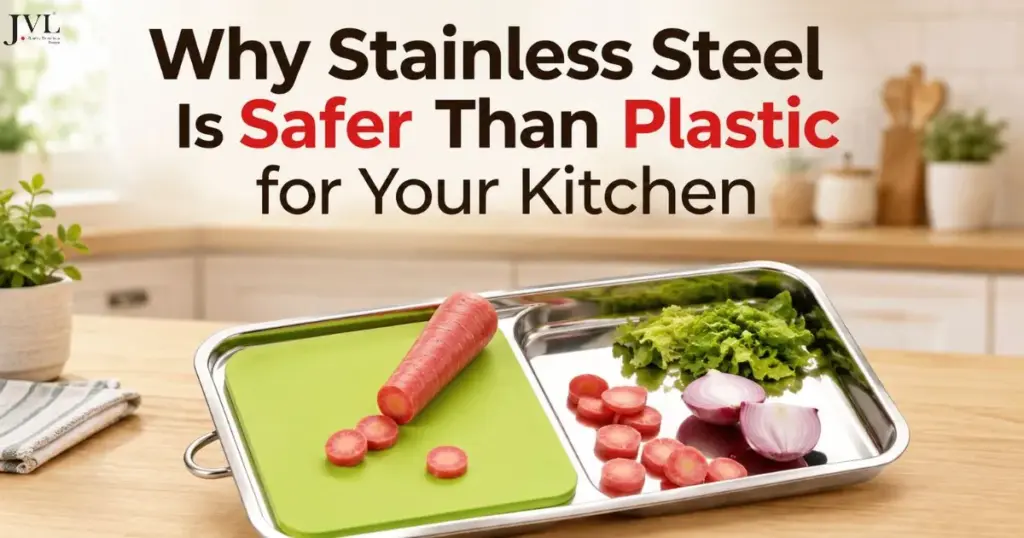
A stainless steel cutting surface eliminates this completely. The >Rectangular Vegetable Chopper from JVL brings food-grade steel to the one kitchen surface where plastic contamination is most directly and measurably entering the food supply. The steel surface does not shed particles under knife contact. It does not absorb the colour or odour of onions, tomatoes or coriander. It wipes clean in seconds and maintains a hygienic food preparation surface without the microplastic risk that every plastic cutting board carries by design.
What a steel chopping surface delivers that plastic cannot:
- Zero microplastic transfer, no particles shed into food regardless of knife type or cutting force
- Non-porous surface that does not absorb the juices of raw vegetables, fish or meat between uses
- Hygienic cleaning, the surface can be sanitised completely without the residue channels that plastic develops
- Structural durability that does not develop deep knife grooves where bacteria accumulate over time
- Food-grade material standard throughout, the surface touching the food meets the same standard as the best cookware in the kitchen
The Chopping Board That Belongs in a Plastic-Free Kitchen
Replacing the cutting surface is one step. The broader question is how the kitchen preparation area functions as a whole, and specifically whether the surfaces, tools and containers involved in food preparation before cooking are as safe as the cookware used during it.
The >Multi Purpose Chopping Board and Counter Top from JVL extends the steel preparation surface into a full counter-top solution. It provides a hygienic, non-reactive food preparation area that functions as a cutting surface, a prep station and a counter extension, all in food-grade stainless steel.
What a steel counter-top chopping board changes about food preparation:
- The entire preparation workflow, from washing vegetables to chopping to transferring to the pan, happens on a surface that does not contaminate the food at any point
- Counter space that previously hosted a plastic board, a plastic tray and miscellaneous plastic prep surfaces is replaced with a single unified steel surface
- Cleaning between food types during active cooking is fast and complete, a wipe with a damp cloth removes all residue from the non-porous steel surface
- The preparation area looks deliberate and organised rather than assembled from whatever surfaces were available
For the household actively replacing plastic with steel, the preparation surface is as important as the storage containers. Food that is prepared on a steel surface and stored in steel containers has had no meaningful plastic contact at any stage of the cooking and storing process.
The Long-Term Cost Argument That Plastic Always Loses
The initial price of a plastic container is lower than the equivalent steel option. This is the argument that keeps plastic in Indian kitchens despite growing awareness of the health concerns. It is also an argument that does not survive even basic calculation when total cost over time is considered.
A quality plastic container in daily Indian kitchen use typically lasts twelve to eighteen months before staining, warping, seal failure or hygienic degradation requires replacement. A food-grade stainless steel container in the same daily use environment lasts ten to fifteen years with no degradation in performance.
The cost calculation over a ten-year period:
- Plastic container replaced every twelve to eighteen months over ten years, six to eight replacement purchases at the price of a plastic container
- Steel container purchased once, used daily for the full ten years, performing identically on day three thousand as on day one
- The steel container costs more at the point of purchase. Over ten years, it costs significantly less. And it does not leach chemicals into your family’s food at any point in that decade.
Beyond cost, the environmental argument for steel is unambiguous. Stainless steel is fully recyclable at the end of its usable life, the material is recovered and re-used without degradation. Plastic containers, particularly the mixed-polymer containers common in kitchen storage, go to landfill. The plastic-free kitchen is not just a health decision. It is a long-term decision about what kind of household it chooses to be.
How to Make the Switch Without Replacing Everything at Once
Switching a full Indian kitchen from plastic to steel is not a single-day project. It does not need to be. The most effective approach is to replace plastic at the point of failure or concern and build toward a complete switch over a realistic timeframe.
Start with the highest-risk plastic in the kitchen:
- Containers used to store hot food directly, replace these first, as hot storage is where leaching is highest
- The cutting board, replace immediately, as microplastic transfer here is direct and daily
- Containers used to store acidic food, tamarind, tomato-based curries, pickle, replace these next
- Containers that show staining, warping or seal failure, these are visibly degraded and leaching at the highest rate
Build out from storage to preparation:
- Replace food storage containers with food-grade steel options in matched sets
- Replace the cutting surface with a steel chopping board or counter-top solution
- Replace plastic serving bowls and plates used for hot food with steel alternatives
- Replace plastic ladles, spatulas and stirring tools with steel equivalents
What does not need immediate replacement:
- Plastic containers used exclusively for cold, non-acidic food storage can be deprioritised
- Plastic packaging from purchased goods can be used until empty and then not replaced with plastic
- Plastic used for storage outside the kitchen, non-food storage, is not the priority concern
The plastic-free kitchen is a direction, not a single event. Every piece of plastic replaced with food-grade steel is a reduction in the chemical exposure the household accepts from its food preparation environment.
The Indian Kitchen That Was Always Supposed to Be Steel
There is a specific irony in the plastic kitchen. Traditional Indian kitchen culture was steel. The thali, the dabba, the kadai, the handi, the storage container, all steel, for generations, across every region of the country. The plastic kitchen is not a tradition. It is a post-independence economic convenience that became normalised before the health implications were understood.
Returning to a steel kitchen is not a step backward. It is a return to the material standard that Indian cooking was built on, and a correction of a decades-long detour into a material that turned out to be less safe, less durable and less appropriate for the specific demands of daily Indian cooking than the steel it replaced.
The household that switches to stainless steel is not making a lifestyle choice. It is making a health choice, a financial choice and a practical choice simultaneously. And it is making a choice that every version of the Indian kitchen that came before the plastic era already understood to be correct.
Explore the full range of food-grade steel kitchen tools in the >Kitchen Accessories collection at JVL Classicware and begin the switch your kitchen has been waiting for.
Frequently Asked Questions About Switching to Stainless Steel
Is stainless steel really BPA free?
Yes, completely. Stainless steel contains no plastic polymers of any kind, no BPA, no BPS, no phthalates and no other plasticisers. The concern with BPA-free plastic is that the replacement chemicals used in its manufacture may carry similar endocrine-disrupting properties. Stainless steel sidesteps this entire category of concern because it is not plastic in any form. There is nothing in food-grade 304 stainless steel that can leach into food under any normal cooking or storage condition.
Can stainless steel containers be used to store acidic Indian food like tamarind curry or lemon rice?
Yes. Food-grade 304 stainless steel is non-reactive with acidic ingredients at the concentrations found in Indian cooking. Tamarind, tomatoes, citrus and vinegar-based preparations can all be stored in steel containers without any chemical interaction between the food and the container surface. This is one of the specific advantages of steel over both aluminium and plastic for Indian kitchen use, Indian cooking is more acidic than most global cuisines, and steel handles that acidity safely.
Does stainless steel leach nickel or chromium into food?
This is a common concern and worth addressing directly. The chromium and nickel in 304 stainless steel are bound in an alloy, not in a form that transfers into food under normal cooking conditions. The chromium oxide layer that forms on the steel surface is what makes it non-reactive, it acts as a barrier between the alloy and the food. Research on stainless steel cookware consistently finds that the trace amounts of nickel and chromium that may transfer into food are well below any established safety threshold and are not considered a health risk for people without specific metal sensitivities.
Why does my old steel container sometimes smell after washing?
A steel container that retains smell after washing is usually the result of a gasket or lid seal that is made from rubber or low-quality silicone rather than the container body itself. The steel body of a quality container does not retain odour. If the smell is coming from the container body rather than the lid component, it is worth checking whether the steel grade is genuinely food-grade, lower-grade steel can develop surface porosity over time that allows odour absorption. JVL containers use food-grade 304 stainless steel throughout, which does not retain odour under normal washing conditions.
Is a stainless steel chopping board hygienic compared to plastic or wood?
Steel is more hygienic than both plastic and wood for food preparation surfaces. Plastic cutting boards develop deep knife grooves over time where bacteria accumulate and cannot be reached by surface washing. Wood is inherently porous and absorbs food juices, bacteria and odour. Stainless steel is non-porous, knife grooves do not penetrate deep enough into the surface to create bacterial reservoirs, and the surface can be cleaned and sanitised completely with normal washing. For a household that is switching to steel for health reasons, the cutting board is one of the highest-priority replacements precisely because of the direct and daily food contact it involves.
How long does a stainless steel kitchen container actually last?
A quality food-grade stainless steel container in daily Indian kitchen use will last ten to fifteen years or more with no meaningful degradation in performance. The steel does not warp, does not stain, does not lose its seal quality in the body material and does not develop the micro-cracking that causes plastic containers to fail. The only components that may require attention over a very long period of use are the gasket or lid seal, which can be replaced without replacing the container body. For practical purposes, a steel container bought today is a kitchen purchase for the next decade.