Cookware · 14 August 2026
The Best Cookware for Indian Cooking That Daily Cooks Choose
Every Indian kitchen runs on a rhythm that is unlike any other in the world. The morning starts with milk boiling on one burner. By afternoon, a dal is simmering on low heat while a curry gets its tadka on high. By evening, rice is being rinsed and a kheer is beginning its slow reduction. Sometimes all of this happens simultaneously, across multiple vessels, on the same stovetop.
No other cuisine demands this range from its cookware — high-heat frying, long slow simmering, acidic tamarind-based gravies, deep frying in oil, and steam cooking — often within the same cooking session.
Choosing the best cookware for Indian cooking is not about finding the most expensive set. It is about understanding which materials and constructions actually survive and perform under these conditions day after day, year after year. This guide gives you that understanding — and helps you make the right choice before spending a single rupee.
Why Indian Cooking Demands More from Cookware
Most global cookware reviews are written with Western cooking in mind — moderate heat, light seasoning, short cooking durations. Indian cooking sits at the opposite end of almost every one of those parameters.
The specific demands Indian cooking places on cookware:
- ** High heat for extended durations** — Tadka, deep frying, bhunao technique, and roasting whole spices all require sustained high heat that many cookware materials cannot handle without warping or coating degradation
- ** Acidic ingredients** — Tamarind, tomatoes, kokum, raw mango, and citrus are used daily in Indian cooking. These acidic ingredients react with certain metals and degrade coatings over time, directly affecting food safety and flavour
- ** Heavy stirring and metal utensil contact** — Indian cooking involves constant stirring, mashing, and scraping — habits that destroy non-stick coatings faster than any other cooking style
- ** Long simmering times** — Dal, biryani, kheer, and slow-cooked gravies require hours of consistent, gentle heat without hotspots that cause scorching at the base
- ** Multiple cooking methods in one vessel** — An Indian pot needs to handle a quick high-heat sear followed by a long covered simmer in the same cooking session
- ** Daily, intensive use** — Unlike occasional-use cookware in many homes globally, Indian kitchen vessels are used multiple times a day, every single day
Understanding these demands is what separates genuinely useful cookware advice from generic recommendations.
Material Comparison: What Works and What Does Not for Indian Cooking
Food-Grade Stainless Steel
Stainless steel — specifically 304-grade or 18/8 food-grade steel — is the best all-round base material for Indian cooking. Here is why it consistently outperforms every other option for daily Indian kitchen use:
- ** Non-reactive surface** — Stainless steel does not react with acidic ingredients like tamarind, tomatoes, or kokum. Your dal and rasam taste exactly as they should, with no metallic interference from the vessel.
- ** High-heat compatible** — Stainless steel handles the full range of Indian cooking temperatures without warping, discolouring, or degrading.
- ** No coating to degrade** — There is nothing to scratch off, chip, or peel. The same surface that works on day one works the same way ten years later.
- ** BPA-free and food-safe** — Food-grade stainless steel involves no chemical coatings or compounds that could leach into food under high heat.
- ** Induction compatible** — Magnetic stainless steel bases work on gas, electric, and induction cooktops — essential as induction becomes increasingly common in Indian urban homes.
- ** Dishwasher safe and easy to clean** — Stainless steel cleans up reliably without special care routines.
For daily Indian cooking — particularly curries, dal, gravies, milk-based dishes, and rice — food-grade stainless steel is the right foundation material.
Non-Stick Cookware
Non-stick is popular in Indian kitchens for a reason — eggs, dosas, and low-oil cooking benefit from the non-stick surface. But non-stick has specific limitations that matter significantly for daily Indian cooking:
- ** Cannot handle high heat** — Most non-stick coatings begin to degrade above 230°C. Tadka, dry roasting, and high-heat bhunao techniques regularly exceed this threshold.
- ** Metal utensils damage the coating** — Indian cooking habits — constant stirring with steel spatulas, mashing with ladles — scratch non-stick surfaces faster than any other cooking style.
- ** Acidic ingredients accelerate coating wear** — Daily use with tamarind and tomato-heavy gravies degrades the coating significantly faster than neutral ingredient cooking.
- ** Coating lifespan in Indian kitchens** — Most non-stick cookware in Indian households shows visible coating wear within 12 to 18 months of regular use. Once the coating is compromised, the vessel is a food safety concern.
Non-stick has its place — a flat non-stick tawa for dosas or eggs. It is not the right primary material for pots, kadais, and everyday cooking vessels.
Cast Iron
Cast iron cookware has genuine advantages for Indian cooking — exceptional heat retention, natural non-stick properties when seasoned, and virtually unlimited lifespan. Its limitations are equally real:
- ** Reactive with acidic ingredients** — Unseasoned or poorly seasoned cast iron reacts with tomatoes, tamarind, and citrus, affecting both flavour and the seasoning layer.
- ** Very heavy** — A cast iron kadai of meaningful size is significantly heavier than its stainless steel equivalent — a daily usability concern for most home cooks.
- ** Requires consistent seasoning maintenance** — Cast iron demands a specific care routine. In humid Indian climates, rust develops quickly on unseasoned or improperly dried cast iron.
- ** Not induction compatible unless enamelled** — Bare cast iron does not work on induction cooktops.
Cast iron is an excellent supplementary material — particularly for slow-cooked dishes like mutton curries and gravies that benefit from its heat retention. It is not the right everyday primary cookware for most Indian home cooks.
Aluminium
Aluminium heats fast and is inexpensive. For Indian cooking, it has one critical limitation — aluminium is reactive with acidic ingredients. Daily contact with tamarind, tomatoes, and citrus causes aluminium to leach trace amounts of metal into food. Hard-anodised aluminium significantly reduces this risk but is not completely eliminated. For food safety in Indian cooking, food-grade stainless steel is the superior choice.
What to Look For When Buying Cookware for an Indian Kitchen
Base Construction: Why It Matters More Than the Body
The base of a cooking vessel determines how heat moves from the flame to the food. A thin single-layer base creates hotspots — areas of the base that run significantly hotter than others. In Indian cooking, hotspots cause scorching in dal, burning at the base of biryani, and uneven reduction in gravies.
A well-constructed base — whether encapsulated, impact-bonded, or multi-layer — distributes heat evenly across the entire surface. Even heat distribution is the single most important technical specification for Indian cooking performance.
Lid Fit and Heat Retention
Indian gravies, dal, and slow-cooked dishes benefit enormously from a well-fitted lid that retains heat, moisture, and aroma during cooking. A loosely fitting lid allows steam to escape, which changes cooking times and reduces the depth of flavour in slow-cooked dishes. Always check that the lid sits flat and seals adequately — not airtight, but close-fitted.
Handle Design and Safety
Indian cooking involves lifting heavy, hot vessels filled with liquid — dal, milk, gravies, and rice water. Handle design is a genuine safety consideration. Handles should be securely riveted or welded, heat-resistant, and designed for a comfortable grip when the vessel is full and heavy. A handle that becomes dangerously hot during cooking is not acceptable for daily use.
Size Compatibility with Indian Cooking Quantities
Indian cooking is rarely done in small quantities. A pot that seems adequately sized empty will be inadequate filled with dal for a family of four. For Indian household cooking, size up — a 2.2-litre pot handles most daily cooking tasks for families of two to four people comfortably. Larger families need 3-litre-plus capacity for primary cooking vessels.
Induction Compatibility
Gas remains common in Indian kitchens but induction adoption is growing rapidly — particularly in urban apartments. A magnetic stainless steel base provides induction compatibility without any additional cost or design compromise. Verify compatibility before purchasing, particularly if your household uses or plans to use an induction cooktop.
Cook-to-Serve Functionality
Indian cooking culture involves bringing the vessel to the table — serving directly from the pot is standard practice for dal, curries, and rice dishes. A well-designed cooking vessel that is also presentable on a dining table eliminates the need for separate serving bowls and reduces the number of dishes to wash. This is a practical consideration that many cookware guides overlook for Indian kitchen contexts.
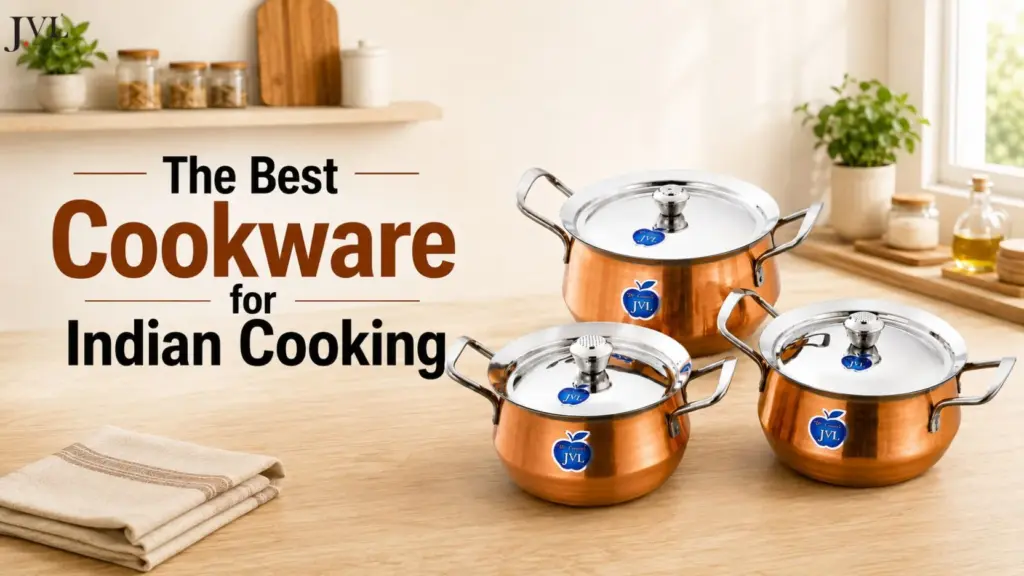
Two JVL Pot Sets Built for Indian Cooking
JVL Classicware has been manufacturing stainless steel kitchenware for over 40 years and is trusted by more than 10 lakh Indian families. Their cookware range is built with a clear understanding of how Indian home cooks actually use their vessels — daily, intensively, and across the full range of Indian cooking methods.
Both pot sets below are built from high-grade rust-resistant food-grade stainless steel, work on gas and induction cooktops, and come in three graduated sizes — 850ml, 1.3L, and 2.2L — covering the full range of daily Indian cooking quantities from tea and milk boiling to full dal and curry batches.
The JVL >Classic Pot Set of 3 is built around a traditional, user-friendly pot shape that distributes heat evenly and works effortlessly for day-to-day Indian meals. The design is clean and functional — a well-fitted lid retains heat, aroma, and moisture during simmering, while sturdy heat-safe handles provide a firm, comfortable grip for safe pouring and serving. Available in Full Copper, Mirror Finish, and Copper Bottom finish variants. The set is dishwasher safe, highly durable, and designed to cook and serve in the same vessel — reducing the number of dishes and keeping the table presentation clean. It is the right choice for households that want a dependable, traditional-format pot set that handles the full range of daily Indian cooking without fuss.
For households that want the same performance with a more refined, modern aesthetic, the JVL >Opus Pot Set of 3 brings a distinctive Opus signature silhouette — an elegant, stylish shape designed for modern Indian kitchens that looks equally at home on the stovetop and on the dining table. Built from the same high-grade rust-resistant stainless steel with a well-fitted lid and sturdy heat-safe handles, the Opus set comes in five finish variants — Mirror Finish, Silver Touch, Copper Bottom, Full Copper, and Hammered Tone — giving buyers the flexibility to choose a finish that matches their kitchen aesthetic. The same three sizes — 850ml, 1.3L, and 2.2L — cover every daily Indian cooking application from milk and tea to full curry and kheer batches. It is the right choice for households that want premium build quality combined with a presentation-ready vessel that works as confidently on a guest table as it does on a daily stovetop.
Cookware Care Guide for Indian Kitchens
Good cookware lasts decades with the right maintenance. These habits apply to all food-grade stainless steel vessels:
- Wash with mild dish soap and a soft sponge — Avoid abrasive scrubbers and steel wool, which scratch the surface and dull the finish permanently
- ** Dry immediately after washing** — Water spots on stainless steel are caused by mineral deposits from water left to air-dry. A quick wipe after washing prevents them entirely
- ** Never heat an empty vessel** — Heating stainless steel without contents can cause warping and discolouration over time. Always have liquid or food in the vessel before applying heat
- ** Store in a dry, ventilated space** — Avoid stacking wet vessels or storing in damp cabinets
- ** For stubborn residue** — A paste of baking soda and water applied to the affected area and left for 10 minutes removes most cooking residue without abrasive scrubbing
The Bottom Line
The best cookware for Indian cooking is not the most expensive option or the most aggressively marketed one. It is the cookware that is built from the right material — food-grade stainless steel — with a base that distributes heat evenly, a lid that retains moisture during slow cooking, and handles designed for the weight and heat of a full Indian cooking session.
Those specifications do not change regardless of which brand you choose. What JVL brings to those specifications is 40 years of manufacturing experience, trusted by over 10 lakh Indian families, and a design philosophy built specifically around how Indian home cooks actually cook — not how global cookware trends assume they do.
Both sets are part of JVL’s full Handi and Pot range, which you can explore at the>JVL Handi and Pot Collection.
Frequently Asked Questions
What is the best material for everyday Indian cooking?
Food-grade stainless steel — specifically 304-grade or 18/8 steel — is the best material for daily Indian cooking. It is non-reactive with acidic ingredients like tamarind and tomatoes, handles the full range of Indian cooking temperatures, has no coating to degrade, and is compatible with all cooktop types including induction. It is the most durable, food-safe, and low-maintenance choice for Indian kitchen conditions.
Is non-stick cookware safe for Indian cooking?
Non-stick is appropriate for specific tasks — dosas, eggs, and low-oil cooking on a flat tawa. It is not suitable as primary cookware for Indian curries, dal, and gravies. High-heat tadka, constant stirring with metal utensils, and daily acidic ingredient contact degrade non-stick coatings significantly faster in Indian kitchens than in most other cooking contexts. Once the coating is visibly scratched or peeling, the vessel should be replaced.
Can stainless steel pots be used on induction cooktops?
Yes — provided the base has a magnetic component. Most food-grade stainless steel pots with an encapsulated or magnetic base are fully induction compatible. Both JVL pot sets featured in this article work on gas, electric, and induction cooktops. Always verify induction compatibility in the product specifications before purchasing.
What size cooking pot is best for a family of four?
A 2.2-litre pot handles most daily cooking tasks for a family of four comfortably — dal, single-vegetable curries, milk, and kheer. For larger batches of biryani or when cooking for guests, a 3-litre or larger vessel is more practical. A graduated set of three sizes — 850ml, 1.3L, and 2.2L — gives you the flexibility to match vessel size to cooking quantity for every meal.
How do I prevent food from sticking to stainless steel cookware?
The most common cause of sticking in stainless steel is adding food to a cold vessel or adding food before the oil is adequately heated. Heat the empty vessel on medium heat for 60 to 90 seconds before adding oil. Add oil and allow it to heat until it shimmers slightly. Then add your ingredients. Food added to a properly preheated stainless steel vessel with hot oil does not stick significantly more than non-stick under Indian cooking conditions.
Is cast iron or stainless steel better for Indian cooking?
Both have genuine advantages. Stainless steel is better for daily cooking — particularly acidic gravies, dal, and milk-based dishes — because it is non-reactive, lightweight, easy to clean, and induction compatible. Cast iron is better for slow-cooked meat dishes and preparations that benefit from exceptional heat retention. For a primary everyday cookware material, stainless steel is the more practical choice for most Indian home cooks.
What should I look for in a cookware set for an Indian kitchen?
The five most important specifications for Indian kitchen cookware are: food-grade stainless steel construction, even heat distribution across the base, a well-fitted lid for moisture retention during simmering, sturdy heat-safe handles designed for heavy-filled vessels, and induction compatibility. A cook-to-serve design that eliminates the need for separate serving bowls is a practical bonus for Indian cooking and dining culture.